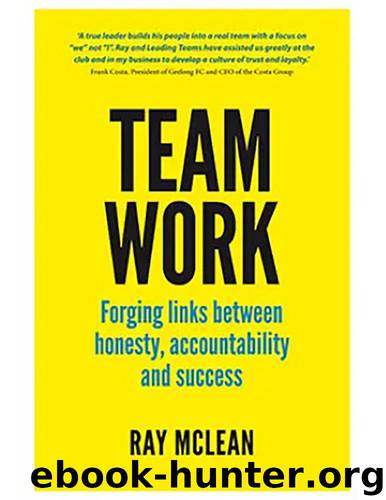
Team Work: Forging links between honesty, accountability and success by McLean Ray
Author:McLean, Ray [McLean, Ray]
Language: eng
Format: epub
Publisher: Leading Teams Australia Pty Ltd
Published: 2020-06-22T16:00:00+00:00
Figure 8: The Trust Model
Bill: I remember wondering what someone who provided support to a footy club would know about local government. That felt like a risk. The notion that we would discuss individual performance in groups, with people who you weren’t accountable to, was also very confronting. There was a lot of anxiety about the peer-assessment process and we had many conversations about whether it was fair or respectful to the individual. Some felt it would be like going to church, gathering every month to have group confessions. Even five years on, some people still wonder whether ranking performance against agreed values and behaviours in a group setting is a constructive thing to do.
In the first year, there were some challenging times, especially around the idea of confessing that you hadn’t lived the values. People would be asked things like, ‘Tell us a time when you thought either you or someone else could have done that better?’ There were periods when there were long silences and Kraig was spending a lot of time listening to his own voice. People were not engaging in the program because they thought it was too risky. They didn’t think it was safe. There were also various times when people were getting sick and tired of football analogies.
Suzie: On many occasions Kraig had to look for inroads. He felt the group wasn’t opening up. At one point, he made the decision to split the group, separating the third-level managers from the CEO and GMs to see if it would help explain why we weren’t buying in.
Bill: Governments are risk-averse, and this permeates the organisational culture. So, when you’ve got a hierarchical organisation that is not into taking risks, and you try to run this sort of organisational development program, that’s a real challenge. People felt that bagging a group manager or the CEO for not adhering to our values might be a career-threatening move. In a very conservative environment this is confronting stuff.
Suzie: I think what broke the ice, when we started to make some real progress, was the relationship assessments.
Bill: Another thing that helped in the early part was that round-table exercise where people are asked, ‘What have you been up to for the last month?’ The first time Kraig ran it, he let the group do the talking, and everything said was very safe. The next time he did it, he launched into a history of cancer in his family. He told people how he was managing his cancer, how his brother was managing his cancer. Then he said, ‘Let’s try that little exercise again.’ Around we went again, and all of a sudden the disclosures were much deeper. It was a very powerful exercise and took relationships to a different level, and that probably helped get people to engage more with each other.
When the peer assessments started, we had a lot of conversations about whether I trusted people to do their job or not, about whether I was too controlling. We’d
Download
This site does not store any files on its server. We only index and link to content provided by other sites. Please contact the content providers to delete copyright contents if any and email us, we'll remove relevant links or contents immediately.
Tools of Titans by Timothy Ferriss(8403)
Change Your Questions, Change Your Life by Marilee Adams(7788)
Deep Work by Cal Newport(7092)
Playing to Win_ How Strategy Really Works by A.G. Lafley & Roger L. Martin(6322)
Man-made Catastrophes and Risk Information Concealment by Dmitry Chernov & Didier Sornette(6029)
Big Magic: Creative Living Beyond Fear by Elizabeth Gilbert(5780)
Digital Minimalism by Cal Newport;(5769)
Ego Is the Enemy by Ryan Holiday(5455)
The Slight Edge by Jeff Olson(5421)
The Motivation Myth by Jeff Haden(5217)
The Laws of Human Nature by Robert Greene(5214)
Stone's Rules by Roger Stone(5091)
Tuesdays with Morrie by Mitch Albom(4791)
Eat That Frog! by Brian Tracy(4546)
Rising Strong by Brene Brown(4467)
Skin in the Game by Nassim Nicholas Taleb(4257)
The Money Culture by Michael Lewis(4212)
Bullshit Jobs by David Graeber(4197)
Skin in the Game: Hidden Asymmetries in Daily Life by Nassim Nicholas Taleb(4012)
